
Parkinson's Treatment Part 1: Medication - Meet Levodopa, the Original Gold Standard

Part 1 of a 3-part series on gold standard Parkinson's treatments. Also in this series: Part 2 — Deep Brain Stimulation, and Part 3 — Physiotherapy, Speech Therapy & OT.
Quick Answer: What Is the Gold Standard Medication for Parkinson's Disease?
Quick Answer
Levodopa (most often combined with carbidopa, and sold under brand names including Sinemet) is the most effective medication for managing the motor symptoms of Parkinson's Disease. It has been the gold standard pharmacological treatment since the late 1960s, and the American Academy of Neurology's 2021 practice guidelines — reaffirmed in 2025 — confirm that levodopa provides superior motor benefit compared to all other drug options in early Parkinson's Disease.
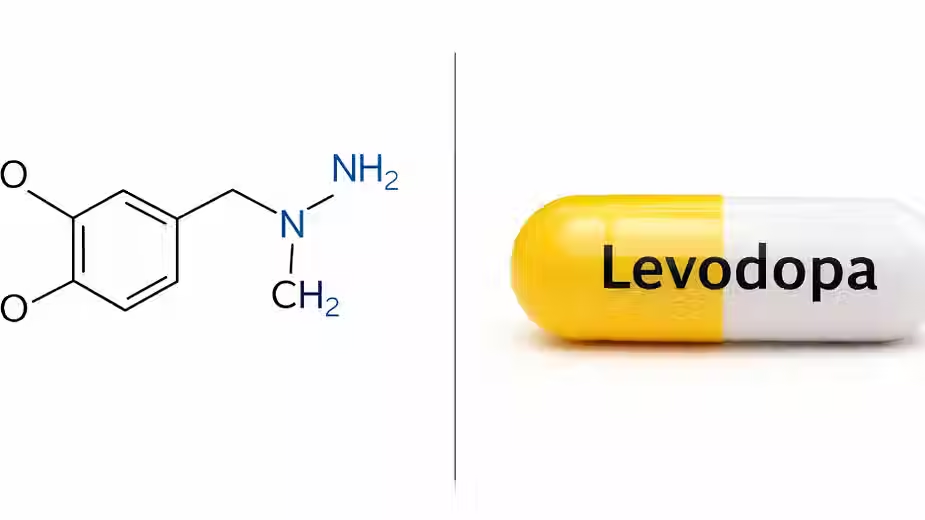
So you've got a Parkinson's diagnosis — or someone you love does — and the very next question on everyone's lips is: Right, so what do we do about it?
Great question! The good news is that treatment for Parkinson's Disease in 2025 is more comprehensive, targeted, and evidence-backed than ever before. We're not just talking about one pill and off you go. We're talking about a whole toolkit of treatments, a multidisciplinary team, and some genuinely impressive science behind it all.
This is Part 1 of our three-part series on gold standard Parkinson's treatments. Today, we're starting with the pharmaceutical cornerstone — the drug that has been the backbone of Parkinson's treatment for over 50 years, and still holds the top spot.
My dear readers, meet Levodopa.
So What Does Levodopa Actually Do?

Remember our friend dopamine? It’s the brain's movement Wi-Fi that gets depleted in Parkinson's. Levodopa is what's called a dopamine precursor. It travels through the bloodstream to the brain, where it gets converted into dopamine. This effectively tops up the supply that Parkinson's has been draining away.
The result? For most people, especially in the early stages, the improvement can be quite dramatic — even at low doses. Tremor, rigidity, and slowness of movement all respond well. It's one of medicine's real success stories. The fact that it's been around since the 1960s and is still the best we've got says something.
Now, levodopa rarely travels alone. It's almost always paired with a drug called carbidopa. Carbidopa stops levodopa from breaking down in the body before it reaches the brain. This means more levodopa gets to where it's actually needed. Importantly, it significantly reduces the nausea that levodopa can cause on its own. The well-known combined formulation is called Sinemet, though the generic carbidopa-levodopa is equally effective and considerably kinder to the wallet.
The Bit Not Always Told Upfront: "On" and "Off" Periods
Here's where we need to have an honest conversation. Nobody loves Levodopa more than we do, but it does come with a catch that's worth knowing about early.
Over time — usually after several years of treatment — many people start to experience what's called motor fluctuations. Basically, levodopa's duration of effect begins to shorten. In the early days, a single dose might give you four to six hours of good movement ("on" time). Years down the track, that window can shrink to two or three hours. The transition in and out of "off" periods — where tremor, stiffness, and slowness return — can become harder to predict and manage.
Some people also develop dyskinesias — involuntary, often writhing movements — as a complication of long-term levodopa therapy. These can be just as disruptive as the original symptoms.
This is why Parkinson's medication management is not a set-and-forget situation. It needs regular review by a neurologist or movement disorder specialist. Often, it evolves over time into combination therapy — adding in other drug classes to smooth out the fluctuations and extend the good hours.
The Supporting Cast: Other Parkinson's Treatment Medications Worth Knowing

Levodopa is the star, but it doesn't always perform solo. Here are the other medications in the Parkinson's pharmacological toolkit:
Dopamine Agonists: These mimic dopamine in the brain. Sometimes used as first treatment in younger patients or added alongside levodopa later. Important note: they carry a higher risk of impulse control disorders (compulsive gambling, shopping, eating). These risks must be discussed openly before starting.
MAO-B Inhibitors: These prevent an enzyme from breaking down dopamine in the brain. Generally mild in effect but useful in early disease.
COMT Inhibitors: These extend the effect of each levodopa dose by blocking a different breakdown enzyme. Useful for managing 'wearing off' as the disease progresses.
VYALEV: Approved in October 2024, this is a new 24-hour continuous subcutaneous infusion of levodopa-based therapy. It’s the first non-surgical option for around-the-clock dopamine delivery. Trial data showed superior improvement in 'on' time without troublesome dyskinesia compared to standard oral therapy.
When Should You Start Medication?
This is one of the most common questions we hear, and the honest answer is: when you need it.
The landmark LEAP study (2019) followed 446 patients over 80 weeks and found no disease-modifying benefit to starting levodopa early versus waiting. In other words, starting medication sooner doesn't slow the disease down — but it also doesn't speed it up. The current clinical guidance is to start levodopa at a low dose, titrate slowly, and time it to when symptoms are actually affecting your quality of life — not before.
This is a conversation to have with your neurologist. There's no universal right answer. It depends on your age, your symptoms, your work situation, and your personal goals.
There’s More to Parkinson’s Care Than Medication
Levodopa remains, after more than 50 years, the most effective medication available for Parkinson's Disease motor symptoms. It doesn't cure Parkinson's, and it doesn't slow it down — but for managing the movement side of things, nothing else comes close.
The key is good management: starting at the right time, adjusting as the disease evolves, and pairing medication with the other pillars of treatment. We cover these in Parts 2 and 3 of this series.
Speaking of which — next up in Part 2, we're diving into the one that always gets the most dramatic reactions: brain surgery.
👉 [Coming Soon - Parkinson's Treatment Part 2: Deep Brain Stimulation - Is Brain Surgery Really on the Table?]
If you’re ready to explore what support might look like for you, Quest Physio Chermside offers physiotherapy for Parkinson’s, including home visits and NDIS support.
📞 Call (07) 3088 8035 for a free 5-min strategy call or visit questphysio.com.au/Parkinsons
This blog is for general educational purposes only and does not constitute medical advice. Please speak with your neurologist, GP, or allied health professional for personalised treatment advice.
Written by Julius Alpay, Physiotherapist
Research Papers Cited
1. Dopaminergic Therapy for Motor Symptoms in Early Parkinson Disease — AAN Practice Guideline (2021, reaffirmed 2025)
American Academy of Neurology (2021). AAN Guidelines
2. Dopaminergic Therapy for Motor Symptoms in Early Parkinson Disease — Full Guideline
Pringsheim T. et al. (2021). Neurology / PMC
3. A Review of Levodopa Formulations for the Treatment of Parkinson's Disease
(2024). Journal of Pharmacy Practice / PubMed
4. Levodopa Infusion Therapies for Parkinson Disease
(2024). Current Opinion in Neurology / PubMed
5. FDA Approves VYALEV for Advanced Parkinson's Disease
AbbVie (2024). AbbVie Press Release
6. Levodopa — Patient Guide
Parkinson's Foundation (2024). Parkinson's Foundation




Comments